
Australian Psychedelic History Project
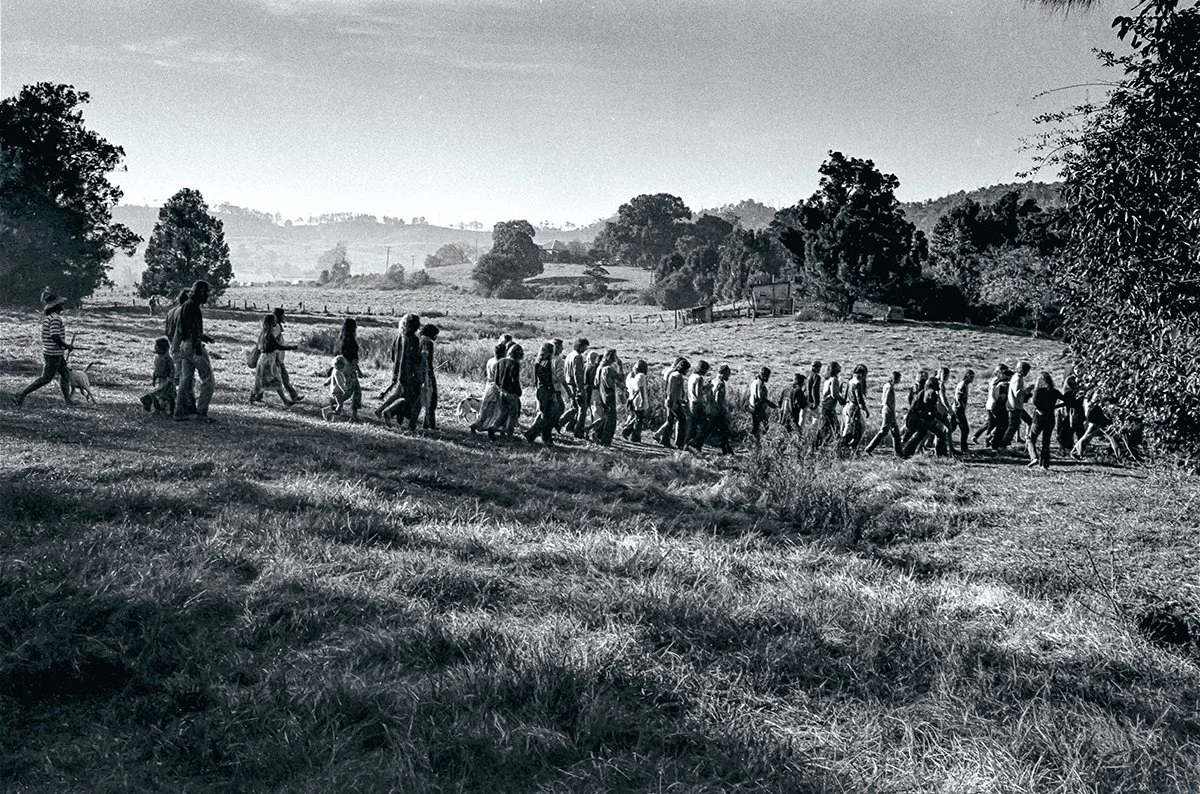
Aquarius Festival, Nimbin, 1973. Photograph by Peter Derrett OAM, used with permission.
Australian Psychedelic History Project
The Australian Psychedelic History Project (APHP) is dedicated to discovering, recording and preserving the stories of people whose lives contributed to, helped shape, or were touched by Australia's psychedelic and ethnobotanical history.
Much of this history was never formally documented. It survives in personal memories, forgotten archives, photographs, letters, artworks, medical files and the stories of people who were there. As time passes, many of these first-hand accounts are at risk of being lost.
Our aim is to build a richer and more human record of Australian psychedelic history by bringing together institutional and medical records, counterculture histories and, most importantly, the voices of people who actually lived through these times.
What Inspired the Project
The inspiration for this project came from the remarkable first-hand testimony of Evelyn Harrison, who was part of Australia’s first wave of psychedelic therapy and research.
Evelyn generously shared her memories of receiving psilocybin-assisted therapy at Melbourne’s Newhaven Private Hospital and beyond in the 1960s. Her personal account brought a largely forgotten chapter of Australian history to life in a way that medical records and archival documents alone could not.
Her courage in sharing her story also highlighted something important: many of the people who lived through this history are getting older, and their memories may disappear if we do not take the time to record them.
Evelyn’s testimony became a cornerstone of our research into Melbourne’s Forgotten Psychedelic Era and helped inspire this project to find, record and preserve more of these voices while we still can.
We’re Interested in Preserving History, While Giving You a Choice About Identification
The aim of this project is to preserve stories that help us better understand Australia’s early psychedelic history. We are interested in the experiences, events and history, and contributors can choose how they would like to be identified.
Some people may be comfortable being recognised as part of this history, particularly where their experience took place in a medical, research or other lawful setting. Others may prefer to protect their identity, particularly when discussing psychedelic use that was illegal at the time or other sensitive experiences.
When sharing your story, consider what level of identification you are comfortable with. You can choose to use your first name and surname initial, a pseudonym, or remain anonymous. We do not collect full names through the story submission form, helping to reduce unnecessary identifying information associated with potentially sensitive historical accounts.
There is no need to identify yourself or other people for your story to be historically valuable. The context of your experience is what matters, and we would like to understand as much of it as possible while helping you balance useful historical detail with privacy and personal circumstances.
Our Current Focus: Up to the End of 1979
The current phase of the project is seeking experiences, memories and historical material relating to Australian psychedelic history up to and including 31 December 1979.
This period spans the formative decades of Australia’s early psychedelic history, from institutional research and therapy in the late 1950s through the counterculture and social changes of the 1960s and 1970s.
Psychedelics moved through many parts of Australian society, across cultural and ethnic groups, the establishment and the underground, from hospitals and consulting rooms to artists, botanists, gardeners, mycologists, musicians, festivals, alternative communities and everyday people.
We are interested in all sides of this history, and everything in between: therapy and research, LSD and psilocybin, psychedelic mushrooms and ethnobotanical plants, art and music, alternative communities, spiritual exploration, underground networks, activism and personal experience.
We also want to understand what happened afterwards. An experience may have occurred before the end of 1979, but its influence on someone’s creativity, spirituality, relationships, activism, work or way of seeing the world may have lasted a lifetime. That continuing story is part of the history too.
While our current collection period ends on 31 December 1979, we are still interested in significant stories from later decades that have helped shape Australian psychedelic history. If you have a story from 1980 onwards that you feel is important, contact us at history@entheogenesis.org.
Want to know more about the kinds of stories and historical details we are looking for? Visit How to Record Your Story for some of the questions we hope to better understand and prompts to help you get started.
First Nations Histories
We welcome appropriate Aboriginal and Torres Strait Islander stories, perspectives and historical material that intersect with the history we are researching, including experiences and encounters up to the end of 1979.
We recognise that Aboriginal and Torres Strait Islander peoples hold diverse and distinct histories, cultural knowledge and relationships with Country, plants, medicines, healing, ceremony and spirituality that long predate the period covered by this project. These relationships should be understood within their own cultural contexts and should not automatically be interpreted through modern Western concepts such as ‘psychedelics’ or ‘altered states of consciousness’.
Aboriginal and Torres Strait Islander peoples comprise many distinct Nations, peoples and communities, each with their own histories, cultural authority, knowledge systems and relationships with Country. Knowledge, practices and authority belong to particular peoples, Countries, families and communities, so we will not assume that information about one Nation applies to another.
Historical sources also require care. Where material comes from non-Indigenous researchers, doctors, anthropologists, botanists, settlers or other observers, we will distinguish their interpretations from First Nations accounts and perspectives. Wherever possible, we will preserve information about the source, Nation, Country, speaker and circumstances in which knowledge was recorded.
We recognise that some knowledge is culturally restricted, collectively held, or not appropriate for a public or research archive. The ability of an individual to tell their own story does not necessarily give them authority to disclose cultural knowledge belonging more broadly to their family, community or Nation.
Our intention is to help preserve history without claiming ownership of First Nations cultural knowledge, and to respect cultural authority, community wishes and the right of First Nations peoples to determine how their knowledge is represented, preserved, accessed and shared.
Where First Nations cultural knowledge, stories or material are contributed, the project will respect Indigenous Cultural and Intellectual Property (ICIP) principles, including appropriate consent, attribution, cultural authority and any restrictions on access, reproduction or publication.
Where relevant, the project will also be guided by the AIATSIS Code of Ethics for Aboriginal and Torres Strait Islander Research, including its principles of Indigenous self-determination, Indigenous leadership, impact and value, and sustainability and accountability.
Whose Stories Are We Looking For?
Above all, we want to hear first-hand accounts from people who were there.
Your story does not need to involve a famous person or major historical event. A seemingly small memory, a person, place, conversation, experience or forgotten detail, may provide an important piece of a much larger historical picture.
Your memories don’t need to be perfect either. You may not remember an exact date or someone’s full name. Tell us what you remember and, where you are uncertain, simply tell us that too.
We also recognise that important histories survive through families, communities and personal archives. If your story concerns a parent, grandparent, relative or someone you knew, and you have direct knowledge of how psychedelics affected their life or those around them, we would also like to hear from you.
You may also hold part of this history without having a story to record yourself. Photographs, letters, diaries, artworks, medical records, flyers, publications and other surviving documents can all help preserve the historical record.

Aquarius Festival, Nimbin, 1973. Photograph by Harry Watson Smith. Creative Commons.
What Makes a Story Australian?
Our primary focus is on people who were living, working or participating in psychedelic research, therapy, culture or communities in Australia.
However, Australian psychedelic history did not always happen within Australia’s borders. We also welcome accounts involving Australians overseas where there is a meaningful connection to Australian history, including encounters with people, institutions or events that later influenced psychedelic research, ideas or culture in Australia.
The important question is not simply where the event happened, but how it connects to the Australian story.
Understanding the Full History
We are interested in the full history. Psychedelic experiences could be positive, challenging, harmful, transformative or a mixture of these, sometimes becoming important moments that shaped people’s lives, creativity, relationships, spirituality or worldview.
Early psychedelic-assisted therapy and research also has a complex history. LSD and psilocybin-assisted therapy took place in Australian hospitals including Newhaven Private Hospital, Epworth Hospital, Mayday Hills and Callan Park Hospital. Medical practices and standards of informed consent were very different from today. Some patients were not fully informed about what they were being given or that their treatment was experimental, and psychedelic drugs were sometimes used alongside other medications.
We want to understand these experiences in their full context: what happened, how people felt about it at the time, and how they feel about it looking back.
Whatever your experience, your story may be an important part of this history and we would like to hear it.
Building the Historical Record
Through oral histories, archival research and historical documentation, we hope to better understand how psychedelics intersected with medicine, science, culture, creativity and people’s lives in Australia.
The Australian Psychedelic History Project is intended to be a long-term historical archive. Stories and materials contributed to the project will be preserved for historical research and may help inform future articles, publications, educational projects and other historical work, always in accordance with the permissions contributors give us.
We recognise that these histories can contain sensitive personal information. Contributors can choose how they are identified and how their recordings and materials may be used.
Names, locations and other identifying or sensitive details may be changed, withheld or removed where appropriate to protect the privacy of contributors and other people mentioned in their accounts, including where someone could be identified from the surrounding details.
Contributors can contact us at history@entheogenesis.org if they would like to update their preferences about how their contribution is identified, preserved or used, or to request withdrawal of their contribution. We will make reasonable efforts to honour these requests, although material already published or shared with permission may not always be possible to completely retrieve or remove.
Most importantly, we want to preserve these memories before they disappear, so they remain part of Australia’s psychedelic history and culture for future generations.
Help Us Find These Stories
You might be reading this and already know someone whose story would be perfect for this project. Perhaps it is a family member, old friend, former colleague, artist, researcher, doctor, patient, musician or simply someone who was there.
Please share this project with them and encourage them to tell their story.
You don’t need to have a story yourself to contribute. Helping this project reach someone who does can help us find and preserve histories that might otherwise disappear.
Every memory can add something to the historical record. If you were there, knew someone who was, or hold a piece of Australian psychedelic history connected to the end of 1979 or earlier, we would love to hear your story.
Have a question about the project or sharing your story? We’d be happy to hear from you at history@entheogenesis.org